iOS TestFlight Beta — Free

Scan the room.
Light it like a DP.

WATT-IF is a lighting design tool. Scan a real location with your iPhone's LiDAR, bake a photometrically calibrated 3D scene with our proprietary mesh engine, drop real cinema fixtures (Aputure, ARRI, ETC Source Four), and export a Set Plan PDF for your Gaffer. Everything you see is physical — candela, lumens, lux, key/fill in stops. Nothing is stylised.

Get the iOS Beta Watch Live Demo
~20–30 min
Proprietary Mesh Bake
±5%
vs. Sekonic L-858
11
Portrait Presets
6
Cine Camera Presets

Scan → Bake → Relight

Your real location. Recreated, then relit.

No one else lets you walk into a location, capture it with your phone, and place physically-accurate cinema fixtures on the captured room — at home, in your hotel, on the plane to the shoot. The WATT-IF Mesh engine is a proprietary textured-mesh pipeline that reconstructs your space with sharp, relightable geometry. Thick-fragment pose-graph optimization corrects ARKit/ARCore drift, TSDF fusion builds a clean surface, and best-view texture projection at 0.4cm resolution delivers photographic detail. User-placed SpotLights cast correct shadows on the actual scanned geometry. It isn't a render preview. It's a relight.

01 / Capture
Walk the room with your iPhone
~half normal walking pace (0.3 m/s). Tilt up to catch the ceiling, down to catch the floor. The HUD counts frames — aim for 100–300. Cover every surface from ≥2 viewing angles.
iPhone 12 Pro+ · LiDAR · ARKit
02 / Upload
Background upload to the cloud
Native URLSession background-config upload. Frames + LiDAR depth + LiDAR confidence + ARKit poses + manifest. Put the phone down — the bake runs on a cloud H100. Push notification fires when ready.
~20–30 min wait
03 / Bake
Proprietary textured-mesh reconstruction
Thick-fragment pose-graph optimization corrects sensor drift. TSDF consensus fusion builds a clean triangle mesh. Best-view texture projection at 0.4cm color resolution delivers photographic sharpness on solid surfaces. Fully proprietary, $0 bakes — no commercial MVS SDKs or external services.
Proprietary Pipeline · 0.4cm Color Detail
04 / Open in Sandbox
You land INSIDE the room
Cinematic 3/4 framing on first frame — corner-anchored, 25% inset from the far wall, 25% perpendicular offset. The room reads with depth, not flat. Drop your first SpotLight — the import baseline tweens to 50% over 200 ms so your light dominates.
60 fps · GLSL 3.00 ES
WATT-IF Mesh (proprietary textured-mesh) Thick-fragment PGO (Open3D) TSDF Consensus Fusion Best-view Texture Projection (0.4cm) Fully Proprietary · $0 Bakes · Apache-2.0 / MIT only

The Sandbox · 5-Tab Right-Panel Remote

Drop a fixture. Read the lux. Match a Sekonic.

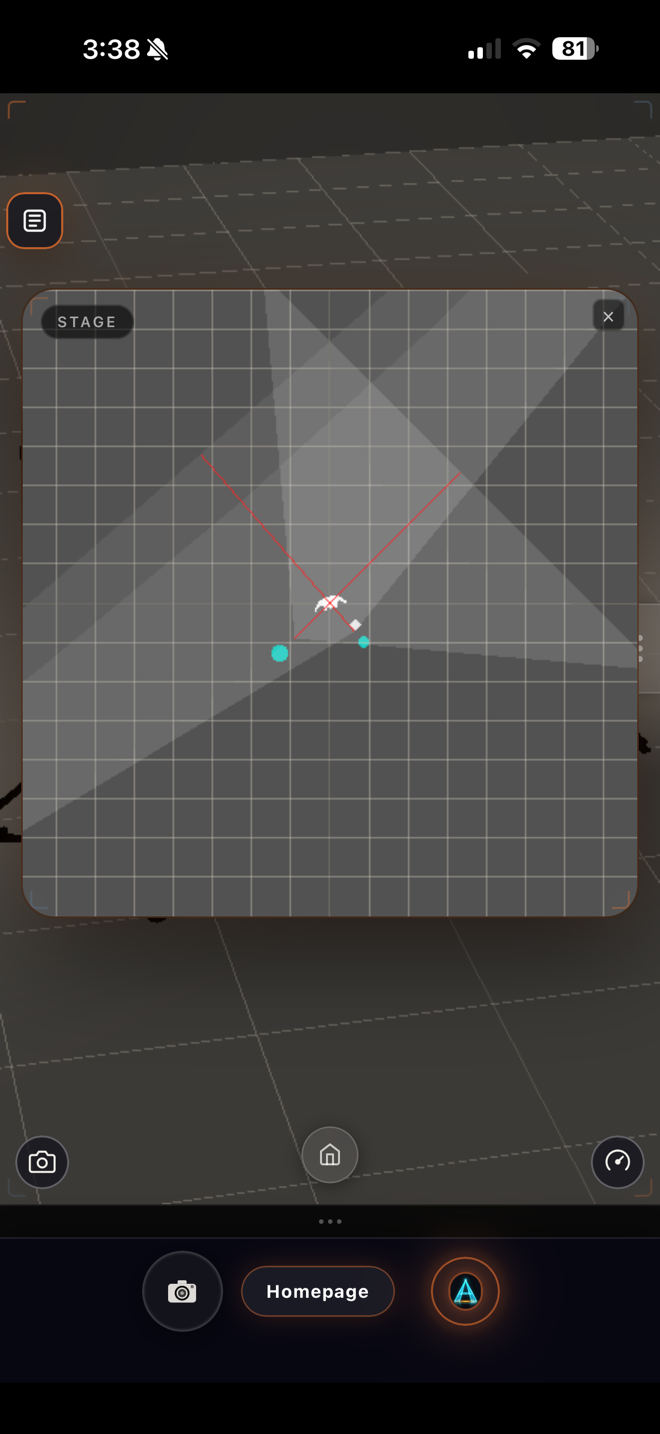
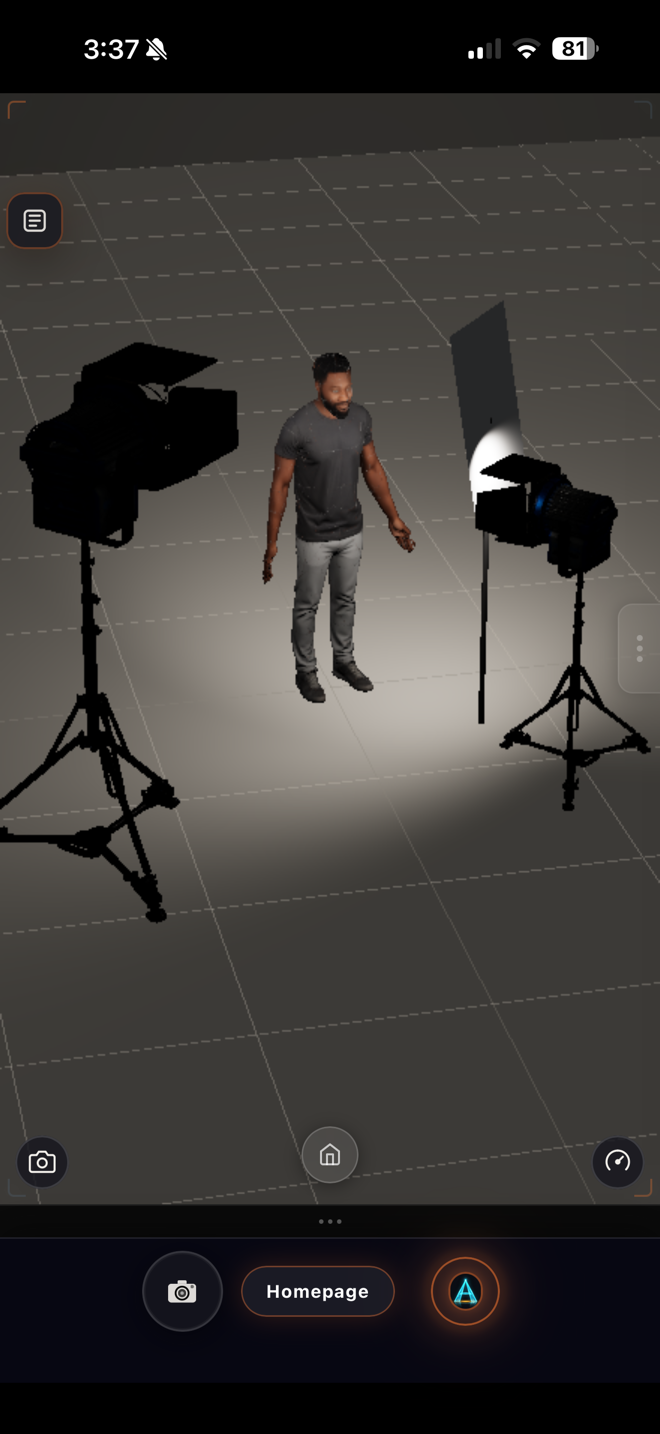
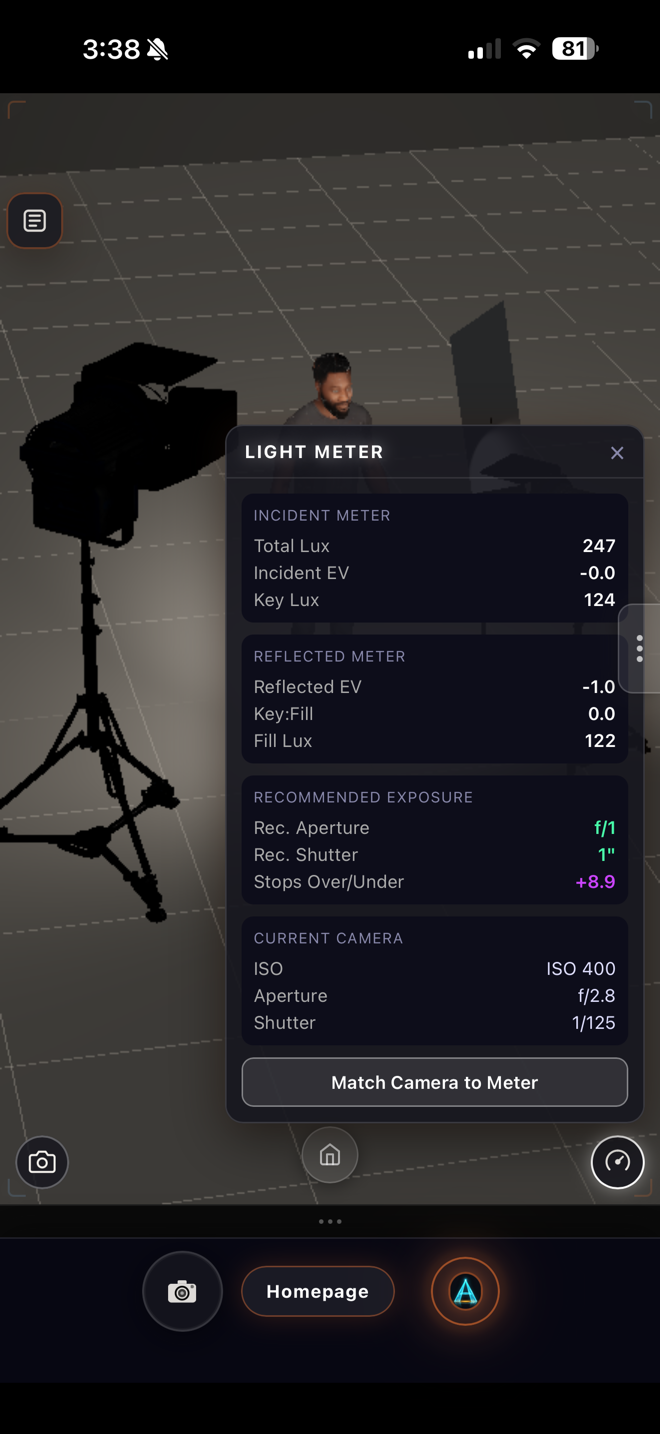
The sandbox right panel ("the remote") is a hero grid of five tabs — Lights, Models, Presets, Camera, Boards. Tap a fixture from the Real-Fixture picker and the active light slot is reconfigured to that fixture's manufacturer-published candela, beam angle, and CCT. The HUD lux meter at the subject matches a Sekonic L-858 incident reading within ±5%. Drop a key. Watch the meter. Dial Power, Modifier, Height, Rotate, Tilt, Gel, and Aim until the numbers match what your DP card needs.

Real fixture catalog

Categorised LED COB, LED Panel, LED Fresnel, Tungsten, HMI, Practical. Aputure, ARRI, ETC Source Four, and more — each at its real manufacturer-published candela.

Roscolux gel library

Pick a named filter from the Rosco library, watch the wall colour shift exactly as the gel transmits the source spectrum. Or override with direct Hue/Sat.

SUBJECT lux + breakdown

One always-visible chip shows total illuminance at the subject. Tap the speedometer for the floating Light Meter: Key Lux, Fill Lux, Key:Fill ratio in stops, EV @ ISO 100, suggested aperture.

11 portrait presets, one tap

Rembrandt, Butterfly, Broad, Short, Split, Loop, Cross, Low Key, Paramount, High Key, Clamshell. Every preset instantiates as a full rig (stand + head + modifier) so you can fine-tune each fixture after.

Recipes — save the look

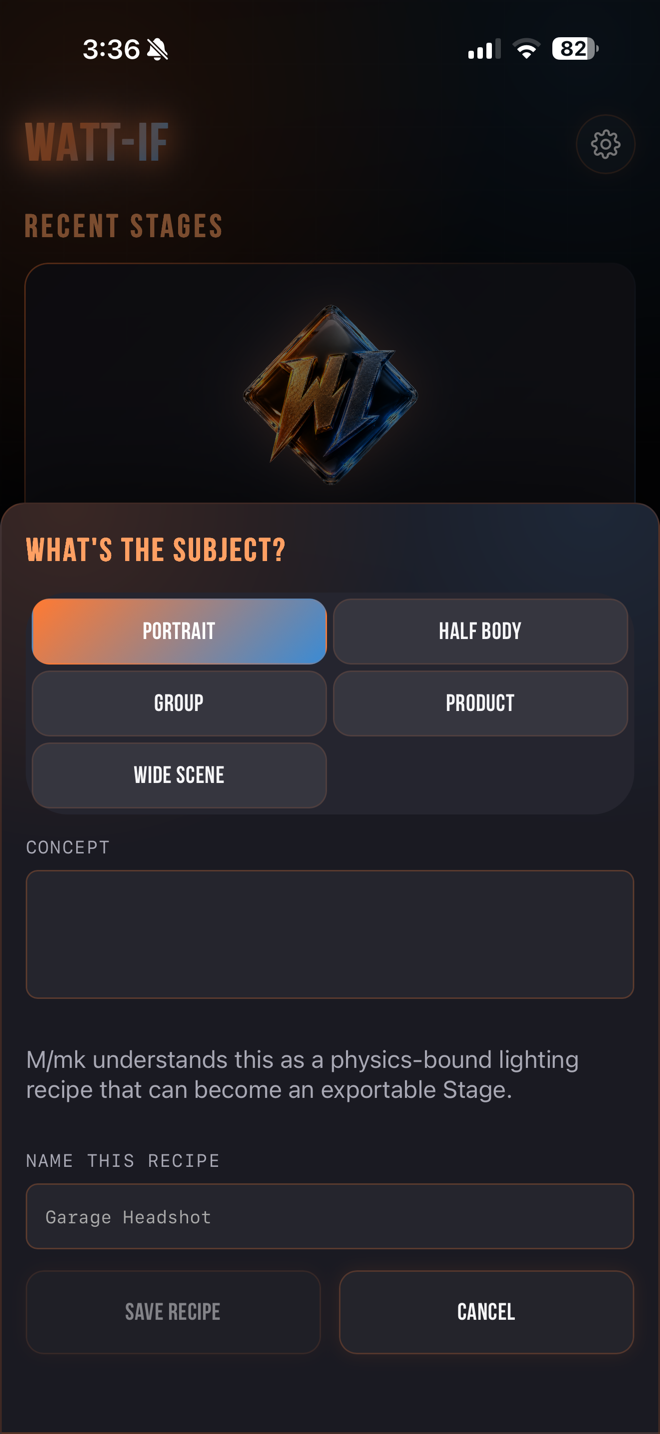
Save any setup as a Recipe (fixtures + camera + subject). Apply later via the bake-directions sheet — Recipes are room-agnostic, so the sheet suggests sensible interpretations for the new room.

Recipe Book — community library

Curated starter recipes you can browse, preview, and copy into Your Recipes for editing. Build a personal shot library that travels with you.

WATT-IF Sandbox with light meter and fixture controls

11 Portrait Presets

The classic recipes, one tap each.

Every preset is a full lighting recipe — key angle, fill ratio, color temperature, modifier shape — built from real portrait technique. Apply one and the full multi-fixture rig drops into your scanned room. Fine-tune any fixture individually after.

Rembrandt
45° key, triangle shadow on cheek
Butterfly
High front key, nose shadow
Broad
Key on near side, wider face
Short
Key on far side, more dramatic
Split
Hard 90° side, half in shadow
Loop
30–45° off axis, small nose loop
Cross
Two equal lights, opposite sides
Low Key
Tight warm key, deep shadows
Paramount
High key + chin bounce + rim
High Key
Soft source, minimal shadows
Clamshell
Key above, fill below — beauty

Set Plan PDF · For the Gaffer

Hand your crew a plan that prints.

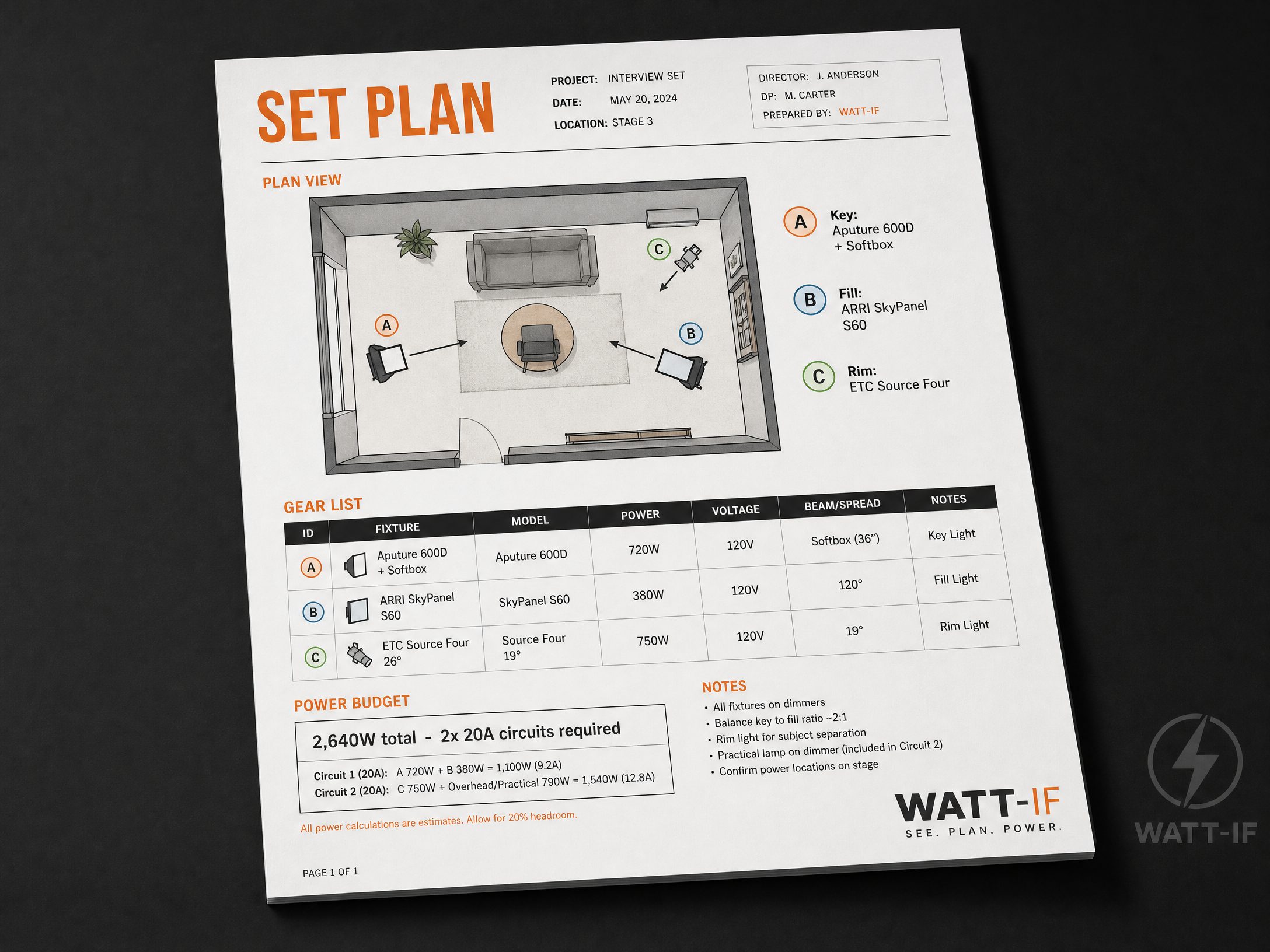
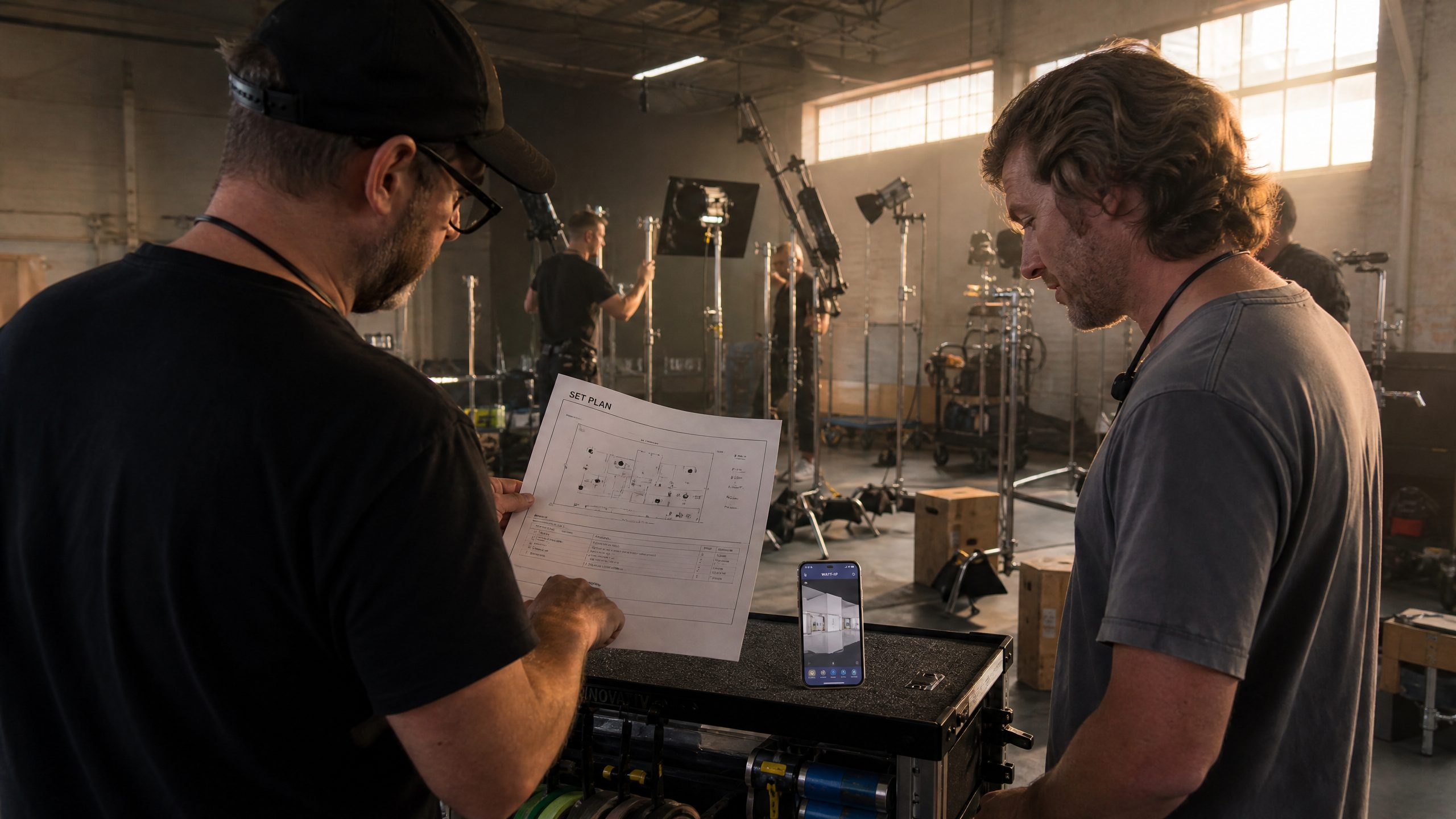
When the design is done, WATT-IF exports a Set Plan PDF: cover page, top-down lighting diagram with every fixture marked, gear table, and an automatic power budget. The Gaffer hangs it on the cart. The electrician runs the circuits to it. The DP signs it.

PDF · Set Plan
First scout day — share with electric department
Single-look layout: cover, top-down diagram, gear table with fixture, modifier, gel, height, distance from subject, and a power budget that calculates total wattage + 15 A and 20 A circuits needed. Red warning fires if any single circuit goes above 1,500 W.
Cover · Diagram · Gear · Power Budget
PDF · Storyboard (coming)
Day-of-shoot — the Gaffer's reference
Multi-shot book with per-shot thumbnails, camera body + lens diagnostic block, top-down lighting diagram, gear table, and per-shot notes. Backend ready; the in-app export button lands next sprint.
Multi-shot · Per-shot diagrams
CSV · Gear
Rental order to the rental house
Per-light spec sheet: fixture name, manufacturer, modifier, gel, cable run, stand, sandbag count. Imports cleanly into rental-house ordering systems.
Rental order
JSON · Digital Twin
Re-import on another device
Full scene state: every fixture pose, modifier, gel, intensity, the subject point, the camera pose, the scanned splat reference. If the shoot reschedules to next week, you can rebuild the entire lighting design with one tap on a different phone.
Scene archive
Power Budget Example

3× Aputure 600D (720 W each) + 1× ARRI SkyPanel S60 (480 W) = 2,640 W total. The Set Plan PDF flags this needs 2× 15 A circuits (1,500 W cap each) or 2× 20 A circuits (1,920 W cap each). Catches the "we can't run all four off one wall outlet" mistake before the truck rolls.


Cine Camera · Real Bodies + Real Lenses

Pre-light through the actual lens.

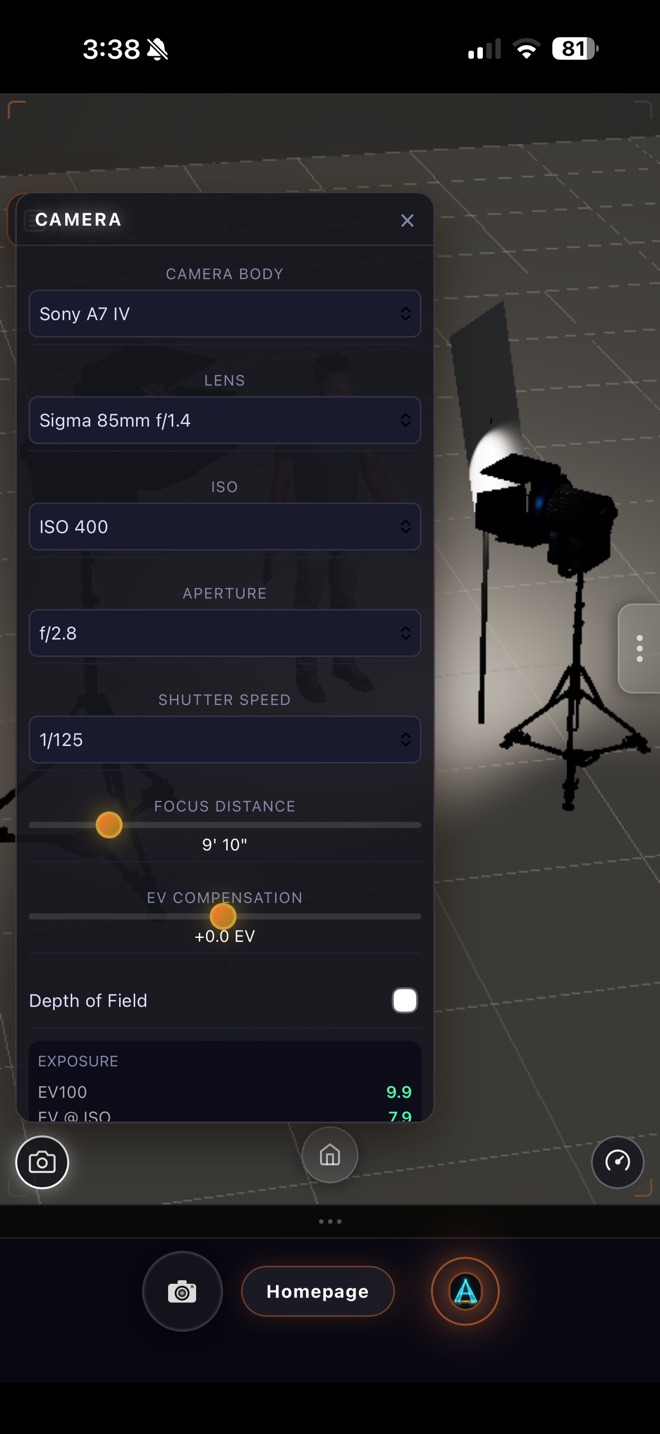
The Cine camera simulates a real photographic exposure triangle — body, lens, aperture, shutter, ISO, focus distance — with depth-of-field and tone mapping. Pick a preset and the FOV snaps to the real-world geometry (FOV = 2·atan(sensor_w / (2·focal_length))), DOF wakes up, exposure scalar updates against the scene lux. You see what your actual camera will see at the actual stop, on the actual sensor, before you rent the lens.

Full-Frame Portrait
Sony A7 IV + Sigma 85 mm f/1.4 Art
@ f/1.8
Environmental 35
Sony A7 IV + Sigma 35 mm f/1.4
@ f/2.8
S35 Cinema 50
ARRI Alexa 35 + Sigma Cine 50 mm T1.5
@ T2.0
S35 Cinema 25
ARRI Alexa 35 + Sigma Cine 25 mm T2
@ T2.8
iPhone 15 Pro Main
The iPhone you're holding
Native
Vintage Tele 135
Sony A7 IV + Sigma 135 mm f/1.8
@ f/1.8
Each preset reports horizontal + vertical FOV, equivalent full-frame focal length, DOF near / far / hyperfocal in metres, exposure scalar, noise rating (Clean / Acceptable / Visible Grain / Heavy Grain), and a motion-blur warning if your shutter is wrong for 24 fps. The lens's real aperture range is enforced (you can't dial T1.0 on a T2 lens), and ISO is clamped to the body's native range.

M/mk AI · Voice Recipe Capture

"Hey M/mk, save this as the softbox key recipe."

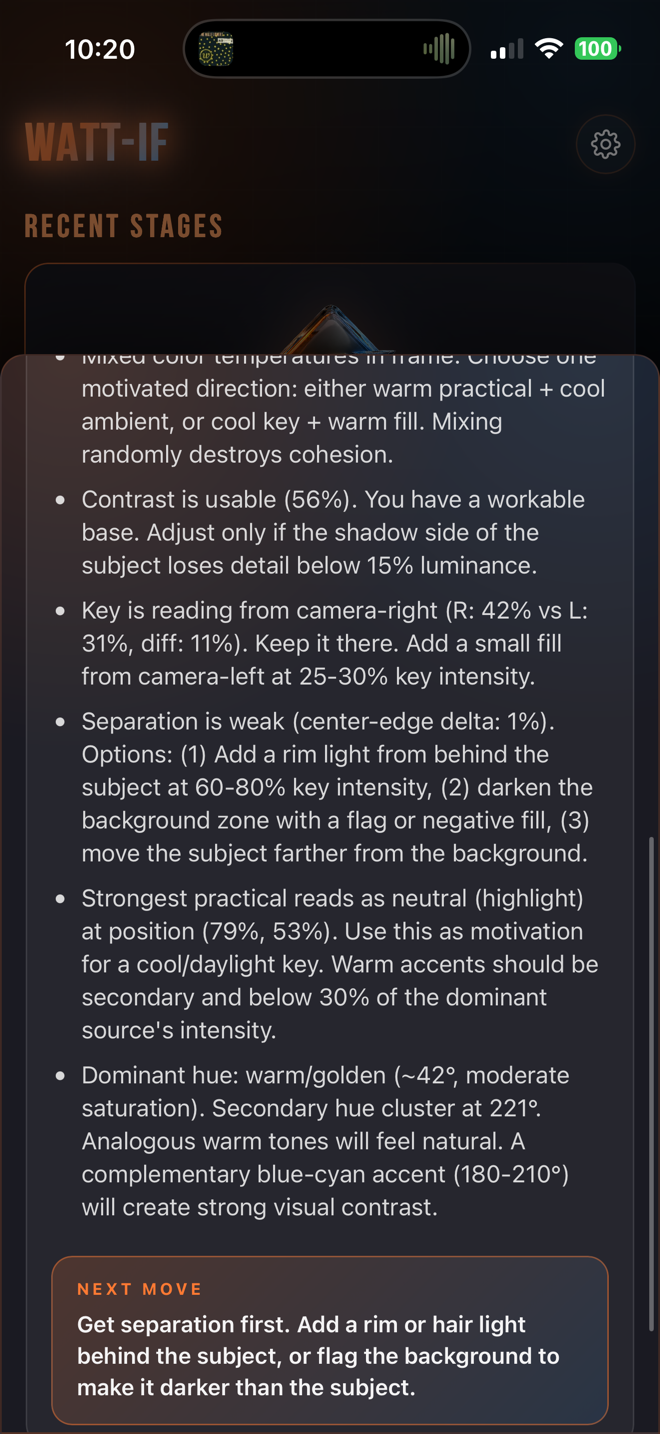
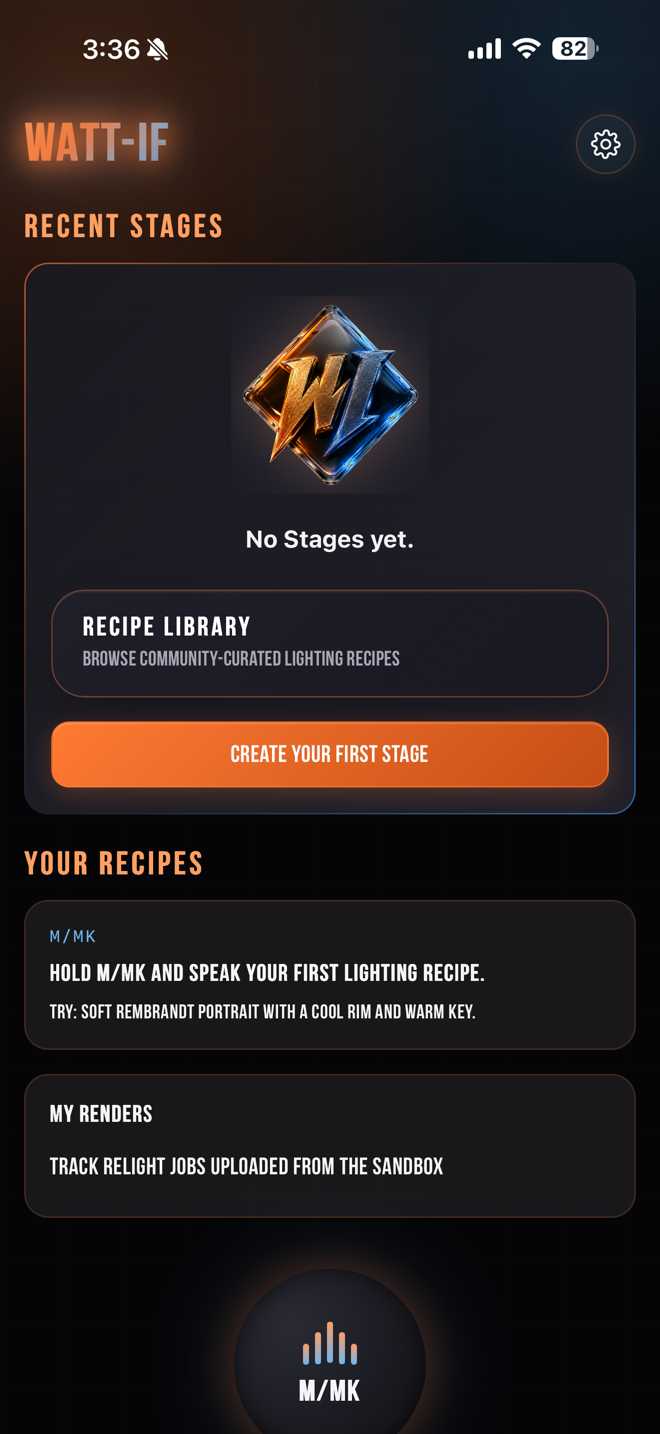
M/mk is the voice-driven recipe-capture surface — press the M/mk avatar in the bottom bar, hold to speak, release to transcribe. M/mk saves your current sandbox state to Your Recipes with the name you gave it. 110 lighting Q&A entries cover ratios, color theory, fixture types, cinematic references, and real-world placement advice — embedded knowledge, not LLM hallucination. A lux-backed Silent Director with suggestion cards is implemented in the codebase and wiring into the UI next sprint.

M/mk AI voice recipe capture

Press-and-hold voice capture

Tap and hold the M/mk avatar, speak the recipe name and intent. Release. The recipe lands in Your Recipes with a thumbnail and the M/mk transcript.

110 lighting Q&A entries

"What's the difference between Rembrandt and Loop?" "Why does the Godfather office look that way?" Embedded knowledge base — answers in plain language, not vague LLM output.

Photometric-grounded suggestions

Silent Director (next-sprint UI) reads the lux meter in real time and suggests fixture moves backed by Sekonic-matching numbers — not vibes. "Your key is at 800 lx, your fill is at 200 lx, ratio is 2 stops, dropping the fill 50% takes you to 3 stops for the noir look you're asking for."

Real-world placement notes

M/mk doesn't just simulate. Recipes carry placement notes — where to put the actual fixture on set, what to clamp it to, which cable run. The PDF includes them.

Cinema Scene Knowledge

M/mk knows these films.

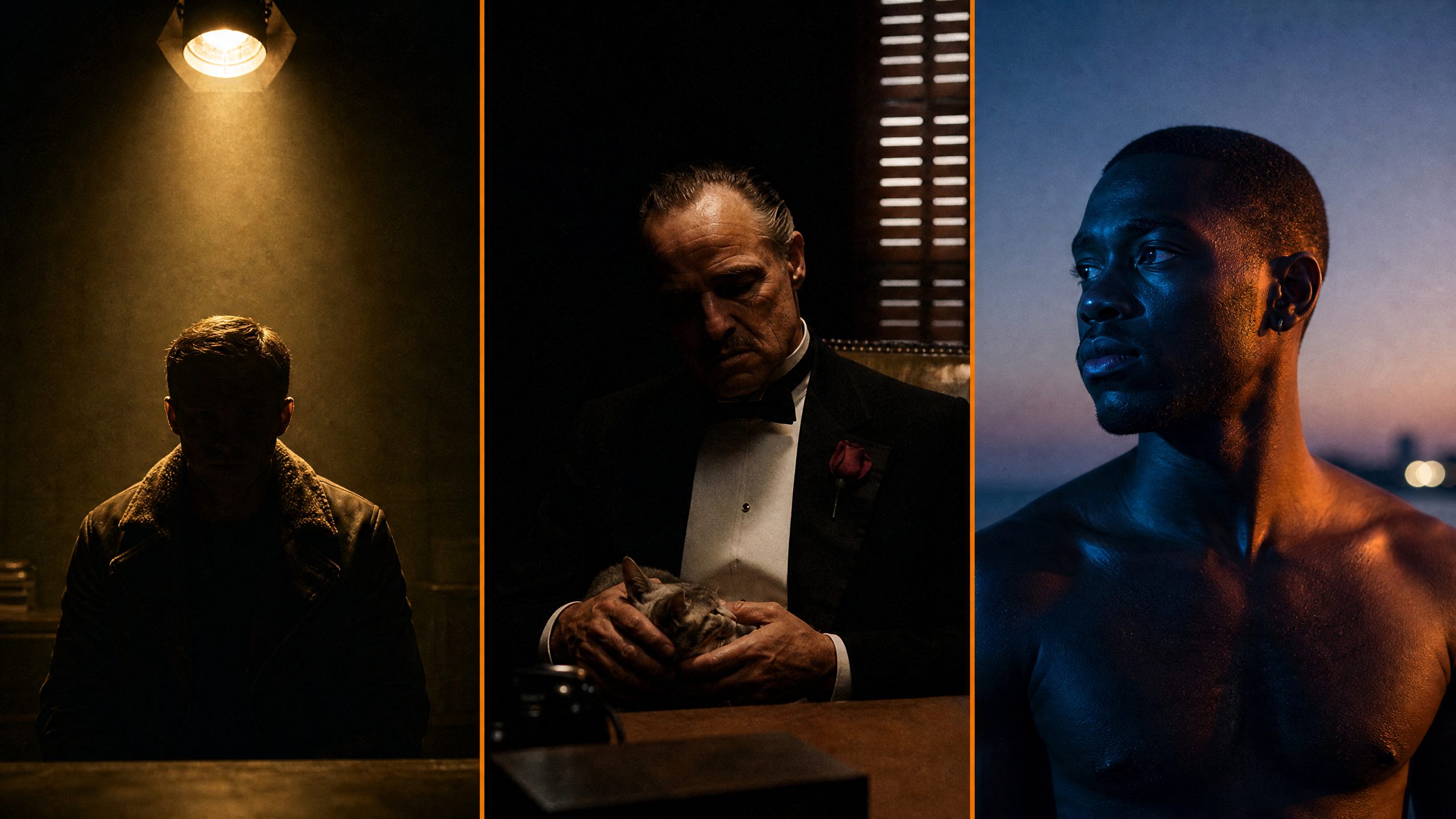
Ask M/mk about any of these scenes and it walks you through the lighting DNA, then guides you to recreate it with real gear in your space — or with virtual fixtures on your scanned splat. Same vocabulary your gaffer uses.

Roger Deakins
Blade Runner 2049 — Interrogation
Single Fresnel overhead at 80° down, warm CTO gel. Eyes go dark. Oppressive, clinical. 10:1 key-to-fill ratio.
Gordon Willis
The Godfather — Office
Overhead key at 80° tilt, warm CTO. Eyes in deep shadow. The Prince of Darkness signature. 8:1 ratio.
James Laxton
Moonlight — Beach
Cool blue key (8000 K, CTB) from camera-right. Warm accent from camera-left. Skin glows against blue shadows.
Emmanuel Lubezki
The Revenant — Forest
Warm backlight (CTO) from directly behind. Cool skylight fill from camera-left. No front key. Golden rim.
Hoyte van Hoytema
Her — Apartment
Giant soft key from camera-right, 4000 K, half-CTO. Matching soft fill from camera-left. Dreamy overexposure.
Linus Sandgren
La La Land — Planetarium
Deep blue under-fill (8000 K) from below. Purple strip lights from both sides. Cool backlight. No warm tones.

A Realistic Day

From pre-light to wrap, in six moves.

WATT-IF isn't a toy. It's the tool that closes the gap between "I know what this should look like" and "the Gaffer rigged it correctly the first time." Here's how a working DP actually uses it.

01
Pre-light morning
You and the Gaffer review the Set Plan PDF over coffee. He flags fixtures he doesn't have. You swap them in the sandbox, regenerate, AirDrop the new PDF. Done in 10 minutes.
02
Camera prep
Open the Cine camera. Body + lens to today's package. Dial the look. Verify the lux on the meter matches what your actual DP card will see at that body / ISO / shutter / aperture.
03
Walk-through
Use the scanned splat to walk talent's blocking before they arrive. Adjust key position if a wall casts a shadow you didn't predict. Spot the problems before they're problems.
04
First setup
Gaffer rigs to the PDF. You take a reference reading with a real Sekonic L-858. Compare to the app. If within ±5% — you're good. If not, room geometry moved (furniture, talent block) — re-scan or adjust.
05
Coverage
Save each new shot as a Recipe. The Recipe library becomes your shot log — you can scroll back through the day's lighting decisions on a meal break.
06
Wrap
Export final Set Plan PDF + a JSON digital twin in case a re-shoot needs the exact same setup tomorrow. The whole shoot is now archived as a re-importable scene.

Live Demo

Watch WATT-IF in action.

When a live demo session is active, you can watch WATT-IF being demonstrated in real time below — capturing rooms, baking splats, placing photometric fixtures, comparing app lux to a real Sekonic. Sessions are announced on social. When offline, grab the iOS beta and try it yourself.

Live Demo Stream
Offline

Follow WATT-IF on social to be notified when the next live demo starts.

Get the iOS Beta
Live Chat
WATT-IF Studio Welcome to the WATT-IF live demo. Ask questions about scan → bake → relight, the Set Plan PDF output, photometric fixtures, or anything you see on screen.

The Creator
Joshiua Cole
Joshiua Cole
Creative Director, Leidos Inc. — Filmmaker — WATT-IF Inventor

WATT-IF was built by a Creative Director and filmmaker who got tired of watching talented people waste hours on lighting problems that could be solved in minutes — if the right tool existed. The gap between knowing what a lighting setup should look like and executing it on set was the problem WATT-IF was designed to close.

With a background spanning high-volume content pipelines, broadcast production systems, and cinematic pre-production, WATT-IF isn't a side project. It's a lighting design tool that speaks the language of light in real units (candela, lumens, lux), reasons about physical fixtures from real manufacturers (Aputure, ARRI, ETC Source Four), and lets you scan your actual location and pre-light it before you load a single case.

The Splat + Relight engine runs on the proprietary WATT-IF Splat trainer — Apache-2.0 / MIT only, zero Inria-licensed dependencies, commercial-clean. Anti-aliasing math from Mip-Splatting (CVPR 2024) and the KNN-init heuristic from LumiGauss (WACV 2025) are both clean-room re-implementations: algorithms in the public domain of ideas, never the encumbered source. Your bake is yours.

Contact for Licensing

Scan a room.
Light it tonight.

The iOS beta is free during TestFlight. Capture your studio, your hotel, your location — bake it in the cloud, drop in real cinema fixtures, and AirDrop your Gaffer a Set Plan PDF before the morning call.

Get the iOS Beta Watch Live Demo

iPhone 12 Pro or later (LiDAR required for capture) · iOS 16+ · Android (ARCore) coming Q3 2026